SAP ECC to S/4HANA Migration Cost and Timeline: 2026 Breakdown vs ERPNext
Benchmark costs by company size, the nine lines every budget needs, how long projects really take, and what the same scope costs on ERPNext over five years.


The first S/4HANA number most ECC customers see covers two things: the subscription and the integrator's fee. A complete budget has nine lines. The seven that are missing are where projects go over.
This guide is for CFOs, CIOs and IT heads who have to put a number in front of a board. It gives published benchmarks for each line, planned and actual timelines, and a worked five-year comparison with ERPNext for a 250-user manufacturer.
One disclosure first. We are Sanskar Technolab, an ERPNext implementation partner. The S/4HANA figures here come from named third-party benchmarks. The ERPNext figures are our own published ranges. We have said where the comparison flatters us.
The short answer

Project cost: $800,000 to $2.2 million for 100-300 SAP users, $2 million to $5.5 million for 300-1,000 SAP users, $5 million to $14 million for 1,000-5,000 SAP users. In case of complex landscapes, it will be two to three times the amount.
Subscription on top: RISE with SAP private cloud runs at roughly $190 to $360 per full use equivalent (FUE) a month for deals of up to 250 FUE.
Timeline: a mid-size brownfield conversion is planned at 9 to 15 months. The median actually delivered is 14 to 20 months.
Overruns: in Horváth's 2025 study of 200 companies, projects ran 30% longer than planned on average, and about two-thirds of completed projects exceeded budget.
The largest variable is your own custom code. How much of it you carry forward decides most of the bill.
Against ERPNext: in our worked example for 250 users, the five-year total is about $1.8 million to $4.1 million on S/4HANA and about $216,000 to $384,000 on ERPNext. Part of that gap is delivery location, not product. We explain below.
What S/4HANA migration costs by company size
The most useful public benchmark we found is from VendorBenchmark, which draws on more than 80 enterprise migrations completed between 2023 and 2025. It bands cost by the number of SAP users and by complexity. "Standard to moderate" means limited to moderate custom code and up to about 50 interfaces. "Complex" means heavy customisation and more than 50 interfaces.
SAP users
Standard to moderate
Complex
Global, multi-instance
SAP users
100 to 300
Standard to moderate
$800,000 to $2.2 million
Complex
$2 million to $4.5 million
Global, multi-instance
Rare at this size
SAP users
300 to 1,000
Standard to moderate
$2 million to $5.5 million
Complex
$5 million to $14 million
Global, multi-instance
$12 million to $22 million
SAP users
1,000 to 5,000
Standard to moderate
$5 million to $14 million
Complex
$12 million to $35 million
Global, multi-instance
$28 million to $60 million
SAP users
5,000 to 15,000
Standard to moderate
$12 million to $30 million
Complex
$28 million to $75 million
Global, multi-instance
$60 million to $150 million and above
A second source generally concurs with this conclusion, which was also made by LeverX, an SAP partner. In September 2026, LeverX issued the following tabulations of costs for ventures in the USA: for a small and not too complicated conversion $750,000-$1.5 million; for a middle-sized brownfield undertaking $1.5-$4 million; for an enterprise transformation $4-$10 million; and for a substantial project spread across the world $10-$25 million.
At the very top, the numbers appear in public accounts. Halliburton reported $154 million of "SAP S4 upgrade expense" in 2025, after $124 million in 2024.
These are project costs, including internal resources. The ongoing subscription or licence is a separate line, and it does not end at go-live.
The nine lines in a complete budget
You should request every point separately. If any individual point does not come back, it has not been eliminated. It has just been shifted towards your domain.
Budget line
Published benchmark
What drives it
Budget line
1. Subscription or licence
Published benchmark
RISE private cloud: about $190 to $360 per FUE a month up to 250 FUE. GROW public cloud: about $80 to $130. On-premise conversion: 15 to 30% uplift on existing licence value
What drives it
User mix, edition, how hard you negotiate
Budget line
2. Integrator fees
Published benchmark
45 to 60% of project spend
What drives it
Scope, integrator tier, onshore or offshore delivery
Budget line
3. Custom code
Published benchmark
From about 17% of budget in one published sample to 40 to 60% of total cost for heavily customised systems
What drives it
How many Z-objects are still in use
Budget line
4. Data migration
Published benchmark
10 to 15% of project cost. Budgets often reach two to three times the first estimate
What drives it
Data quality and how much history you keep
Budget line
5. Integrations
Published benchmark
About 12% in the LeverX sample. Budget it separately above 50 integration points
What drives it
Number of interfaces and third-party systems
Budget line
6. Testing
Published benchmark
About 13% in the LeverX sample
What drives it
Processes, integrations and custom code in scope
Budget line
7. Change management and training
Published benchmark
About 5% in the LeverX sample
What drives it
Users, sites and how much the process changes
Budget line
8. Your internal team
Published benchmark
20 to 35% of total cost in large migrations
What drives it
How many people you take off their day jobs, and for how long
Budget line
9. Dual running and extended maintenance
Published benchmark
ECC maintenance at around 22% of licence value a year, plus two percentage points from 2028, paid alongside the new subscription
What drives it
Project length
Then add contingency. Tachyon recommends 15 to 20% for mid-market migrations.
How the subscription is counted
SAP prices its cloud ERP in full use equivalents, not named users. One advanced user is one FUE. Five core users make one FUE, and thirty self-service users make one FUE. So 250 users is not 250 FUE. A mix of 40 advanced, 110 core and 100 self-service users comes to about 66 FUE.
SAP does not publish a list price for RISE. Redress Compliance, working from more than 700 negotiations, reports opening asks of $220 to $360 per FUE a month for deals of 40 to 250 FUE, and $190 to $230 as achievable at 250 FUE. The private cloud minimum is 40 FUE.
If you stay on-premise
You can still run S/4HANA on a perpetual licence. VendorBenchmark puts the conversion from ECC at a 15 to 30% uplift on your existing licence value. Maintenance continues at around 22% of licence value a year for Enterprise Support. That fee is linked to inflation with a 5% cap, and 2-Data reports increases of up to 5% in each of 2024, 2025 and 2026.
One published budget, line by line
LeverX published an illustrative brownfield budget for a company with 2,500 users, three countries and 150 interfaces. It shows how the project lines stack up before any subscription.
Workstream
Amount
Share of total
Workstream
Custom code
Amount
$1,250,000
Share of total
17%
Workstream
Testing
Amount
$1,000,000
Share of total
13%
Workstream
SAP configuration and conversion
Amount
$900,000
Share of total
12%
Workstream
Integrations
Amount
$900,000
Share of total
12%
Workstream
Data migration
Amount
$750,000
Share of total
10%
Workstream
Internal project resources
Amount
$750,000
Share of total
10%
Workstream
Contingency
Amount
$650,000
Share of total
9%
Workstream
Change management and training
Amount
$400,000
Share of total
5%
Workstream
Architecture and security
Amount
$350,000
Share of total
5%
Workstream
Cutover and hypercare
Amount
$350,000
Share of total
5%
Workstream
Assessment and planning
Amount
$250,000
Share of total
3%
Workstream
Total
Amount
$7,550,000
Share of total
100%
Why custom code decides the bill
Custom code is the largest single line in that sample, and the estimates for it vary more than for any other line. LeverX's sample puts it at 17% of the budget. Redress Compliance says Z-code remediation typically runs to 40 to 60% of total migration cost. Tachyon describes fewer than 500 custom objects as a minor cost and 5,000 or more as months of remediation work.
The spread exists because custom code is where your business lives in ECC. A pricing rule, a dispatch sequence, a quality hold, an approval chain: each one was written in ABAP because standard SAP did not do what you needed. On the way to S/4HANA, every one of those objects has to be checked against the new data model. Under SAP's "clean core" approach, logic you want to keep is moved out of the core and rebuilt as an extension.
So a large part of an S/4HANA budget pays for moving your own workflows into a new extension model that SAP defines and SAP can change. This is the point at which the cost question becomes a control question. If you are going to pay to rebuild those workflows, you can choose where they are rebuilt.
On ERPNext they are rebuilt in Python and JavaScript on the open-source Frappe Framework. The code is yours. Your own developers can read it and change it, and no vendor release calendar sits between you and the next change. The licence saving matters too, but for most enterprise buyers it comes second to that.
One practical step applies whichever route you take. Before you ask for any quote, run usage logging on ECC across a full month-end. The count of custom objects that are still executed is often well below the count that exists, and it is the number every quote should be based on.
Not sure how much of your custom code still matters?
Share your module list and custom object count. We will tell you what needs rebuilding and what can be retired.
How long it takes: planned against actual
Plans and outcomes differ enough that you should budget on the outcome. VendorBenchmark reports both.
Route
Planned
Typically delivered
Route
S/4HANA brownfield, standard to moderate
Planned
9 to 15 months
Typically delivered
14 to 20 months
Route
S/4HANA brownfield, complex
Planned
15 to 24 months
Typically delivered
20 to 30 months
Route
S/4HANA greenfield
Planned
12 to 20 months
Typically delivered
16 to 26 months
Route
S/4HANA selective data transition
Planned
14 to 22 months
Typically delivered
18 to 28 months
Route
S/4HANA global rollout
Planned
24 to 48 months
Typically delivered
30 to 60 months
Route
ERPNext, full ECC replacement, mid-size enterprise
Planned
6 to 12 months
Typically delivered
8 to 16 months if the same 30% slip applies
Horváth's 2025 study of 200 companies points the same way. Projects took 30% longer than planned on average. Fewer than one in ten completed transformations kept to schedule. A quarter exceeded budget heavily and another 40% strongly, and 65% reported strong or very strong quality deficits in the result.
The causes respondents gave were not technical: scope added during the project, weak project management, underestimated testing and data migration, and slow decisions. Those risks apply to an ERPNext project as well, which is why we have applied the same 30% to our own range in the table.
Timing now carries a cost of its own. A mid-size brownfield project started in October 2026 and delivered in 14 to 20 months finishes between December 2027 and June 2028. Mainstream maintenance for ECC ends on 31 December 2027, so most such projects should budget for at least a year of extended maintenance. Our guide to every SAP ECC deadline sets out the dates and conditions.
Worked example: 250 users, S/4HANA against ERPNext
Consider an organization that has three factories and 250 users on ECC 6.0, operating FI, CO, MM, SD and PP and has around 400 Z-programs. There are 40 advanced users, 110 core users and 100 self-service users, resulting in 66 FUE.
Route A is a brownfield conversion to S/4HANA private cloud under RISE. Route B is a replacement with ERPNext. Both are costed over five years, with the same 20% contingency on the project.
Line
S/4HANA private cloud
ERPNext
Line
One-time project
S/4HANA private cloud
$800,000 to $2,200,000
ERPNext
$70,000 to $200,000
Line
Contingency at 20%
S/4HANA private cloud
$160,000 to $440,000
ERPNext
$14,000 to $40,000
Line
Subscription or licence, five years
S/4HANA private cloud
$871,200 to $1,425,600
66 FUE at $220 to $360 a month
ERPNext
$0
Line
Hosting, five years
S/4HANA private cloud
Included in the subscription
ERPNext
$12,000 to $24,000
Line
Support, five years
S/4HANA private cloud
Included in the subscription
ERPNext
$120,000
$24,000
a year, the top of our published range
Line
Five-year total
S/4HANA private cloud
About $1.83 million to $4.07 million
ERPNext
About $216,000 to $384,000
On these figures the ERPNext route costs roughly a tenth of the S/4HANA route over five years. The gap after year five is wider, because the subscription continues and the ERPNext project cost does not repeat.
Want this table with your own numbers?
Send us your user mix, modules and custom object count. We will build the five-year comparison for your landscape.
What the comparison leaves out
A tenfold gap deserves suspicion. Here is where it comes from, and where it could narrow.
Part of the gap is geography.
Our delivery team is in India. The S/4HANA benchmarks reflect mostly US and European integrator rates of $1,600 to $3,600 a day for a consultant at specialist and top-tier firms. VendorBenchmark puts the saving from offshore-led S/4HANA delivery at 35 to 55% of consulting fees, with timelines 15 to 25% longer. That narrows the project line. It does not touch the subscription line.
Our figures are published ranges, not a quote.
We used the enterprise band from our ERPNext implementation cost guide. An ECC replacement with heavy ABAP logic and many years of history is priced after an assessment and can exceed the top of that band.
It still holds under stress.
If our project cost came in at three times the top of the band, the ERPNext five-year total would be about $864,000. That is still under half the low end of the S/4HANA range.
Neither column includes everything.
Your internal team's time, ECC maintenance paid during dual running, and licences for third-party tools are left out on both sides.
There may be a small overlap.
VendorBenchmark's project band includes some licensing increments. If you remove the first year of subscription to allow for that, the S/4HANA range becomes about $1.66 million to $3.78 million.
The S/4HANA subscription uses opening prices.
A well-negotiated deal lands lower. At $190 per FUE, the five-year subscription for 66 FUE is about $752,000.
Cost is not all the consideration as well. It is a worthy purchase in situations where you use SAP industry solutions, payroll in multiple countries in SAP, operate in a conglomerate that requires SAP, or have an ongoing program at work. Then, the proper comparison would be between S/4HANA pricing and not different products. For other options within the market, visit our guide to SAP S/4HANA alternatives.
Eight questions to put to every quote
These apply to an S/4HANA quote. Questions four to seven apply just as much to an ERPNext quote, including ours.
1
What is the price per FUE, and what user mix was assumed?
Ask for the count of advanced, core and self-service users behind the number.
2
What is the renewal uplift cap, in writing?
Redress Compliance reports a standard ceiling of 3.3% and renewal quotes 15 to 20% higher where the contract had no protective wording.
3
Can the FUE count go down during the term?
In many contracts it can only go up.
4
How many custom objects are in scope, and who pays if the count is wrong?
5
What data volume and how many years of history is the migration priced on?
6
Is it fixed price or time and materials?
VendorBenchmark finds fixed-price contracts typically 10 to 18% below time-and-materials estimates for the same scope.
7
How many months of dual running are assumed, and who pays if it runs over?
8
What does year six cost?
Ask for the renewal price now, while you still have a choice.
See ERPNext cost ranges by company size.
Hosting, implementation and year-one totals from 10 users to 500 and above.
Frequently asked questions
What is the price to migrate from SAP ECC to S/4HANA?
According to VendorBenchmark based on over 80 migrations, a moderately complex migration project costs around $800,000 to $2.2 million for businesses having 100 to 300 SAP users. The range becomes $2 million to $5.5 million for 300 to 1,000 users while the range increases to $5 million to $14 million for 1,000 to 5,000 users. It is important to note that for complex landscapes, the cost doubles to triple. It should be kept in mind that subscription/license fee is excluded from these costs.
How long does an SAP ECC to S/4HANA migration take?
A mid-size brownfield conversion is typically planned at 9 to 15 months and delivered in 14 to 20 months. Greenfield projects are planned at 12 to 20 months and delivered in 16 to 26. Global rollouts run from 30 to 60 months. Horváth's 2025 study found projects take 30% longer than planned on average.
What is the biggest cost in an S/4HANA migration?
Integrator fees are the largest category, at 45 to 60% of project spend. Within the work, custom code is usually the largest and least predictable line. Estimates range from about 17% of budget in one published sample to 40 to 60% of total cost for heavily customised systems.
How much does RISE with SAP cost per user?
SAP prices RISE per full use equivalent, not per user, and publishes no list price. Redress Compliance reports about $190 to $360 per FUE a month for private cloud deals of up to 250 FUE and $140 to $220 at 800 FUE and above. One advanced user is one FUE, five core users are one FUE and thirty self-service users are one FUE.
Is brownfield more economical than greenfield for S/4HANA?
For a bespoke mid-tier solution, most likely yes. The brownfield migration retains your configurations and data, and it's estimated at 9 to 15 months versus 12 to 20 months for greenfield. While greenfield requires process and change management, there is no existing code that needs to be replaced. For a smaller business, a cloud-based greenfield approach will probably be the most economical.
Do S/4HANA migrations go over budget?
Often. In Horváth's 2025 study of 200 companies, a quarter of completed transformations exceeded budget heavily and another 40% strongly. Fewer than one in ten finished on schedule. The main causes were added scope, weak project management, and underestimated testing and data migration.
Is it cheaper to move from SAP ECC to ERPNext than to S/4HANA?
In our worked example for a 250-user manufacturer, the five-year total is about $1.8 million to $4.1 million on S/4HANA private cloud and about $216,000 to $384,000 on ERPNext. ERPNext has no licence or per-user fee. Part of the gap reflects India-based delivery rates, and a heavily customised ECC replacement is priced after an assessment.
Can we avoid the migration cost by staying on SAP ECC?
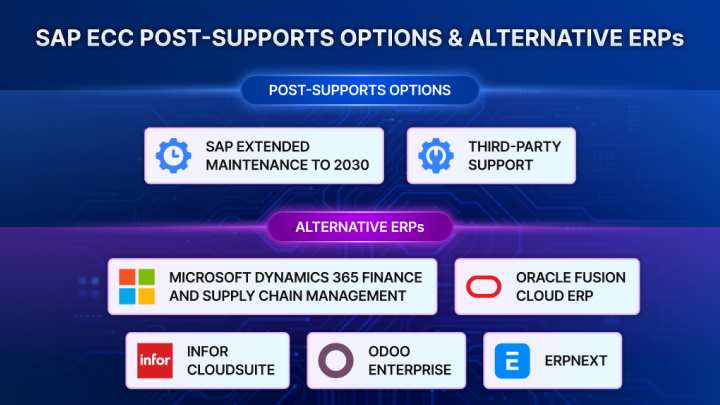
For a while. Extended maintenance keeps ECC supported to the end of 2030 for two percentage points more on your maintenance rate, and third-party support providers typically charge about half of SAP's fee. Neither removes the eventual migration, and SAP's support for third-party databases in ECC also ends in 2030.
Do we still pay licence fees after moving to S/4HANA?
Yes. On RISE or GROW you pay a subscription for as long as you use the system. On-premise, you keep a perpetual licence and pay maintenance of around 22% of licence value a year, with inflation-linked increases capped at 5%.
Put a second number next to your S/4HANA quote
Send us your user mix, modules and a count of custom objects. We will return a fit-gap against ERPNext and a five-year cost comparison on the same scope. If S/4HANA is the better fit, we will say so.
Author

Anand Thakker is the Founder and CEO of Sanskar Technolab, an Ahmedabad-based ERPNext implementation partner with 100+ implementations across dairy, distribution, EPC and financial services.
Share


Sources
- VendorBenchmark: SAP S/4HANA migration cost benchmarks, updated April 2026 (cost by user band, timelines, day rates, component shares)
- LeverX: SAP S/4HANA migration cost in the U.S., October 2026 (planning ranges and sample budget)
- Redress Compliance: SAP FUE price per unit benchmark bands, September 2026 (FUE prices, ratios, minimums, renewal uplift)
- Redress Compliance: S/4HANA migration cost estimator (custom code share)
- Tachyon: SAP S/4HANA migration costs in 2026, March 2026 (data migration share, contingency, custom object thresholds)
- Horváth, April 2025: study of 200 companies on S/4HANA transformations
- Halliburton: fourth quarter 2025 results (SAP S4 upgrade expense)
- 2-Data, August 2026: SAP's annual support fee increases (Enterprise Support rate and 5% cap)
- USU: RISE with SAP licensing (definition of FUE)
- SAP News Center, February 2020: maintenance commitment for Business Suite 7 (extended maintenance premium)
- Sanskar Technolab: ERPNext implementation cost guide (ERPNext ranges used in the worked example)
Disclaimer
Trademarks. SAP, SAP ECC, SAP S/4HANA, SAP HANA, RISE with SAP and GROW with SAP are trademarks or registered trademarks of SAP SE or its affiliates in Germany and other countries. VendorBenchmark, LeverX, Redress Compliance, Tachyon, Horváth, 2-Data, USU and Halliburton are names or trademarks of their respective owners. These names are used only to identify the products and organisations discussed.
No affiliation. Sanskar Technolab is an independent ERPNext implementation partner. It is not affiliated with, endorsed by, sponsored by or partnered with SAP SE or any other company named in this article.
Information, not advice. This article is general information and is not legal, licensing, financial or contractual advice. SAP does not publish list prices for RISE with SAP. All SAP prices here are third-party estimates as of October 2026 and may change. Your own SAP contract and quotes determine what applies to you.
Third-party figures. Cost benchmarks, prices, timelines and survey results attributed to VendorBenchmark, LeverX, Redress Compliance, Tachyon, Horváth, 2-Data and Halliburton are quoted from the published sources cited above. They belong to their authors and have not been independently verified by Sanskar Technolab. Percentage shares marked as our calculation are derived from those figures.
Our own figures. ERPNext costs and timelines are Sanskar Technolab's published ranges and project experience and are indicative. The worked example is illustrative, describes no real customer, and is not a quotation or an offer. Actual scope, cost, duration and results vary by organisation. Comparisons between products are based on publicly available information and general industry experience.
Accuracy and corrections. We have taken reasonable care to make this article accurate at the date shown, but it is provided "as is", without any warranty that it is complete, current or free from error. Sanskar Technolab accepts no liability for any loss arising from reliance on it. Verify anything important to your decision against the original sources and your own contracts. If you believe a statement here is inaccurate or out of date, write to info@sanskartechnolab.com and we will review it and correct it promptly.
Related post
ERPNext
SAP S/4HANA Alternatives: 7 Options for Companies Still on SAP ECC
S/4HANA is SAP’s answer to the ECC deadline. It is not the only one. Here are two ways to stay on ECC longer and five ERPs that can replace it, judged on control, scale and stability before cost.


15th October, 2026

17 min read

ERPNext
SAP ECC End of Life: 2027, 2030 or 2033? Every Deadline and Migration Option Explained
There are three possible dates being circulated, and all three are valid. Below is who each date pertains to, how much it costs, the additional fees charged by SAP in October 2026, and six options for moving forward.
9th October, 2026
20 min read
ERPNext
What Business Leaders Learned from Frappe Yatra Ahmedabad 2026
See how ERPNext, open source software, and automation help businesses standardize processes and improve decision-making.

2nd June, 2026
7 min read


