Best ERP for the Dairy Industry in India: 2026 Buyer's Guide
What Indian dairies actually buy, what each option costs, and twelve questions that tell a real dairy ERP apart from a general ERP with a dairy brochure.

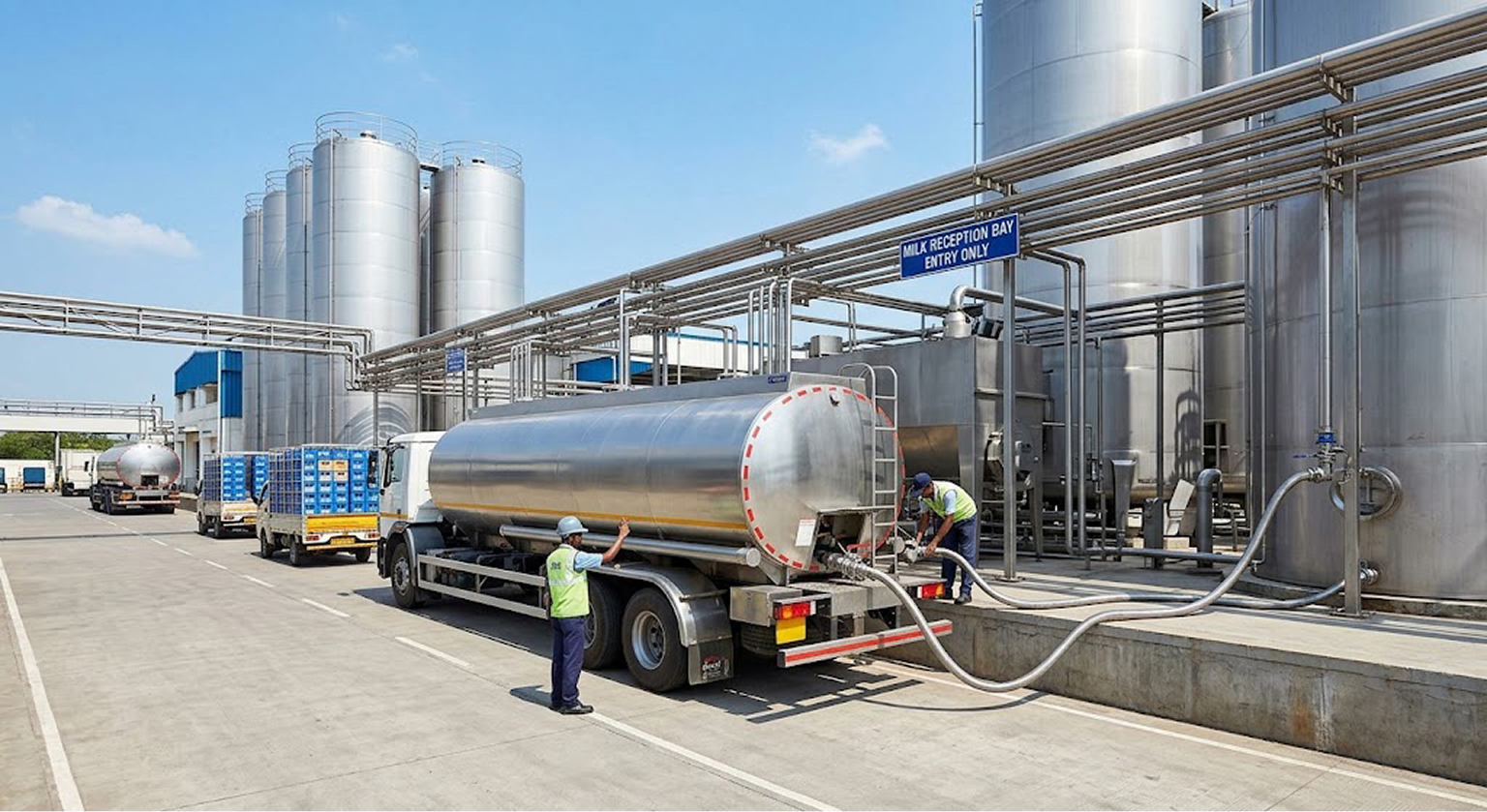
Every dairy ERP demo looks good for the first twenty minutes. Purchase orders, stock ledgers, a neat dashboard. Then someone from your procurement team asks, "Can it pay 4,000 farmers every ten days on a kg-fat rate, after cutting cattle feed and advances?" That question usually decides the meeting.
This guide is for owners and managing directors of private dairies, milk unions and federations in India who are comparing ERP options in 2026. It covers the kinds of software dairies here really buy, what each is good and bad at, what it costs, and how to test a vendor before you sign.
One disclosure first. We are Sanskar Technolab, and we build a dairy ERP on ERPNext. We have tried to write this the way we would want it written if we were the buyer. That includes saying where our own product is the wrong choice.
The short answer
There is no single best ERP for every dairy in India. It depends on your daily volume and on how many plants and entities you run. As a rule of thumb:

Village society, BMC or small milk trader:a milk collection app with Tally is enough. You do not need an ERP yet.
Private dairy with daily processing capacity of 20,000 to 2 lakh litres: a specialized ERP for the dairy industry that is based on a flexible platform like ERPNext is often the most efficient way to use the budget.
Milk unions or federations that have multiple processing units: first, you should shortlist the suitable candidates from SAP S/4HANA, Microsoft Dynamics 365 and an open-source ERP for dairy based on ERPNext. Then, you will need to take a decision on how often you will change the system and how much you can afford to spend on licenses every year.
Why the ERP question is sharper in 2026
Three factors affecting Indian dairies in 2026
There have been some changes in the dairy sector in India in only over a year since 2025.
First, the volume of milk being produced have continued to increase. The volume of milk in India reached 247.87 million tonnes, which is an increase of 3.58 percent compared to the previous year. With the increasing amounts of milk produced, it is anticipated that some co-operatives will be able to raise procurement from 660 lakh kg of milk a day to 1,007 lakh kg by 2028-29. This would mean that there would be more cooperatives, routes and new farmers being recruited thus leading to additional tasks for the similar office.
Second, profit margins have become lower. The dairy sector is challenged by increasing prices of factory made products. For example, Amul and Mother Dairy have increased the price of milk cartons by ₹2 per litre in May 2026.
Finally, the compliance has become stricter recently. In March 2026, FSSAI issued a directive, which states that milk manufacturers need to have a license to operate in the country.
A notebook-and-Excel setup can carry one of these. It struggles with all three at once.
Why a general ERP struggles inside a dairy
Most ERPs were designed for factories that buy a few hundred materials from a few hundred suppliers at agreed prices. A dairy breaks almost every one of those assumptions.
You buy twice a day from thousands of suppliers, and every pour has its own price. The rate depends on the FAT and SNF of that sample. Amul Dairy's June 2026 revision, for example, put buffalo milk at ₹875 per kg of fat.
Farmers are paid in cycles, not invoice by invoice. Every 7, 10 or 15 days you settle each account net of advances, cattle feed, loan instalments and incentives.
You buy litres but you sell fat and SNF. A plant has to reconcile the fat and SNF that arrived in tankers against what left in products and what is still in the silos. The gap is your real loss.
One raw material becomes many products. The same milk turns into toned milk, cream, butter, ghee, paneer and whey, so costing has to split one input across several outputs.
Shelf life is counted in days. Indents arrive in the evening, vans leave before dawn, and the crates have to come back.
Tax is mixed. Fresh milk is exempt and ghee is not, sometimes on the same invoice.
An ERP can be excellent at finance and still handle none of this without heavy modification. So the first thing to settle with any vendor is simple: do these functions exist in the product today, or will they be built for you after you sign?
The five kinds of software Indian dairies buy
Almost every dairy in India runs on one of these five, or a mix of them.
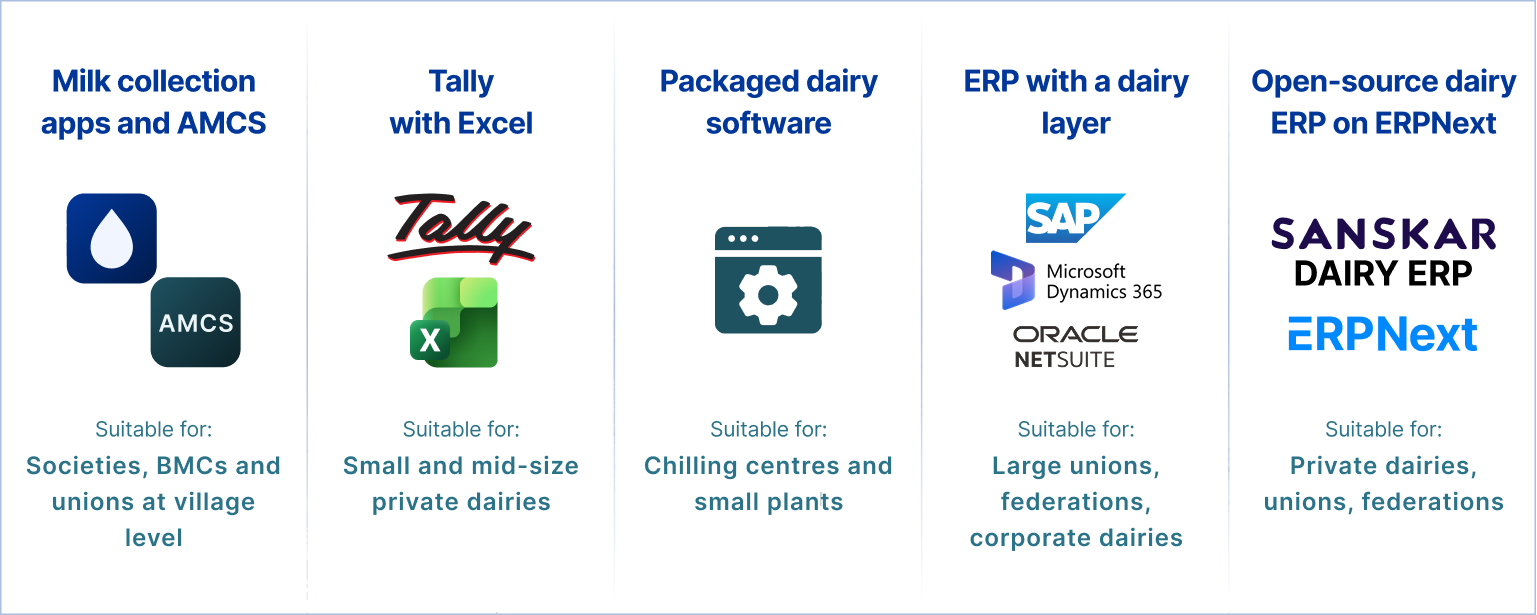
Option
Typical buyer
What it does well
Where it falls short
How you pay
Option
Milk collection apps and AMCS
Typical buyer
Societies, BMCs and unions at village level
What it does well
Weighing, FAT/SNF capture, farmer slips, payment registers
Where it falls short
Stops at the dock. No plant, stock, sales or finance
How you pay
Per society or device. Low
Option
Tally with Excel
Typical buyer
Small and mid-size private dairies
What it does well
Accounts, GST and statutory returns
Where it falls short
Milk bills, fat balance and crates live in Excel
How you pay
One-time licence. Low
Option
Packaged dairy software
Typical buyer
Chilling centres and small plants
What it does well
Quick to start, familiar dairy screens
Where it falls short
Little room for your own workflows. Check multi-plant and data access
How you pay
Licence plus annual maintenance
Option
ERP with a dairy layer SAP S/4HANA, SAP Business One, Microsoft Dynamics 365, Oracle
Typical buyer
Large unions, federations, corporate dairies
What it does well
Deep finance, audit comfort, large partner network
Where it falls short
Dairy procurement comes from a partner add-on. Per-user licences. Changes are slower and cost more
How you pay
Per user, plus implementation
Option
Open-source dairy ERP on ERPNext NDDB Dairy ERP, Sanskar Dair ERP
Typical buyer
Private dairies, unions, federations
What it does well
No licence fee, full access to the code, workflows shaped to your process
Where it falls short
Core ERPNext needs a dairy layer. The result depends on the partner
How you pay
Implementation, hosting and support. No per-user fee
1. Milk collection apps and AMCS
These sit at the society and the bulk milk cooler. They read the weighing scale and the milk analyser, print the farmer's slip and keep the payment register. They are everywhere: NDDB's AMCS alone covers over 26,000 dairy cooperative societies and 17.3 lakh milk producers across 54 unions, and Prompt AMCS reports more than 47,000 active societies on its website. Stellapps and a number of mobile apps serve the same need.
They are not ERPs and do not claim to be. Whatever ERP you choose must take data from the collection system you already have, because nobody is going to replace analysers in 800 villages.
2. Tally with Excel
Most of the private dairy companies initiate and start this process with Excel. Tally manages accounts and GST returns properly. However, it faces the problem of managing with case-specific milk situations such as farmer billing, rate lists, tanker reconciliation, and crate delivery by route in Excel sheets operated by only about two or three people – manageable issue until one of them goes away on leave during the payment cycle. If it takes more than a day for the team to process the ten days’ payment, the current arrangement has exceeded its limits.
3. Packaged dairy software
Several Indian vendors sell ready-made dairy packages for chilling centres and small plants. They install quickly and the screens feel familiar to dairy staff. Before buying, check three things. Can it consolidate more than one plant? Can you get your data out in a usable form? And what happens when you need a workflow the product does not have?
4. Global ERP with a dairy layer
SAP and Microsoft are proven at scale. Amul has worked with SAP for over two decades. If your federation has a trained SAP team and auditors who know the system, that is a real asset and you should not throw it away lightly.
The limits are worth knowing too. FAT/SNF procurement and farmer payment are not part of the standard product. They come as a partner's add-on or as custom development. Licences are charged per user. As a benchmark, Dynamics 365 Business Central is typically quoted in India at around ₹5,500 to ₹6,500 per full user a month. For 150 full users that is close to ₹1 crore a year before implementation, though cheaper limited-user licences bring the figure down. And every change to a workflow goes through the partner, usually at a day rate.
5. Open-source dairy ERP on ERPNext
ERPNext is an open-source ERP with no licence fee. On its own it does not know what SNF is, so it needs a dairy layer on top. That is the route NDDB took. Its NDDB Dairy ERP is built on Frappe ERPNext, runs at organisations including Jharkhand Milk Federation, West Assam Milk Union and Varanasi Milk Union, and won an International Dairy Federation innovation award in 2022. Our own product, Sanskar Dair ERP, follows the same approach.
The main advantage is control. You have the code, so a new incentive scheme or a change in deduction rules is a small configuration or development job. It is not a change request waiting on someone else's roadmap. The saving on licences matters, but it comes second.
The risk is just as plain. The result depends almost entirely on who implements it. Ask for dairy references, not general ERPNext references.
Considering the ERPNext route?
See how Sanskar Dair ERP handles procurement, farmer payments, plant and dispatch in one system.
Twelve things to ask in every demo
Do not accept slides for any of these. Ask the vendor to show each one live, on your own data where possible.
1
Rate chart.
Load our actual rate chart for cow and buffalo milk. Now change the rate from tomorrow's morning shift. What happens to bills already generated?
2
Payment cycle.
Run a ten-day cycle for 500 farmers with feed, advance and loan deductions, and produce the bank file. How long did it take?
3
Collection hardware.
Which analysers and weighing scales does it read today? What happens at a society that has no network for six hours?
4
Tanker reconciliation.
Show society dispatch against dock receipt for quantity, FAT and SNF. Where is the variance booked? How is sour milk handled?
5
Fat and SNF balance.
Show one day's balance for one plant: opening stock plus receipts, against products, closing stock and loss.
6
Yield and costing.
For one batch of paneer or ghee, show actual yield against the norm, and the cost per kg after by-products.
7
Traceability.
Pick a pouch batch. Trace it back to tankers and routes, and forward to distributors. Time it.
8
Indent to dispatch.
Take evening indents, close them at a fixed cut-off, print route-wise loading sheets, and show the crate ledger and leakage returns the next morning.
9
Tax.
Raise one invoice with exempt milk and taxable ghee. Generate the e-invoice and the e-way bill.
10
Multiple units.
Consolidate two plants and a cattle feed unit. Show stock transfers between them.
11
Ownership.
Who owns the data and the customisations? Could another partner, or our own IT team, maintain the system if we part ways?
12
Support.
A dispatch invoice fails at 4 am. Who picks up the phone, and how fast?
Then ask for one customer of your size and type, and call them without the vendor on the line.
Put us through these twelve checks.
Bring your rate chart and one payment cycle. We will run all twelve live on a call.
Which option fits which dairy
Three typical cases. The numbers are illustrative, but you will probably recognise one of them.
Case 1
A BMC or milk trader, 8,000 litres a day
One collection point, a few hundred farmers, bulk sale to a bigger dairy. A collection app and Tally cover this comfortably. Put the money into a reliable analyser and a good weighing scale. An ERP here adds work without adding control.
Case 2
A private dairy, 60,000 litres a day
One plant, three chilling centres, forty routes. Pouch milk, curd, paneer and ghee. Today it runs on a collection app, Tally and a lot of Excel. Farmer payment takes three days to close, nobody is sure whether paneer makes money, and crates go missing every month.
This dairy needs a real dairy ERP, but probably not a tier-1 system. With 40 to 60 users, per-user licences become a noticeable cost, and the owner will want changes made in days. A dairy ERP on ERPNext, or a strong packaged product, is the natural shortlist.
Case 3
A milk union, 5 lakh litres a day
Around 900 societies, two plants, a cattle feed plant, and reporting to a state federation. Both a tier-1 ERP and an open-source dairy ERP can run this. The decision comes down to four questions:
Do you have staff with SAP or Dynamics technical knowledge?
Is there any requirement from the Federation or the State regarding the platform?
Do your purchasing procedures change frequently?
What budget do you have for licenses over the next ten years?
If the federation has standardized on SAP and the system is working, it generally makes sense to continue using SAP. However, if the organization is starting afresh or if the existing system is unable to adapt to the new rules, it is advisable to consider the option of using an open-source program.
What a dairy ERP really costs
Quotes are hard to compare because vendors include different things. Break every quote into four bills.
Licence.
Charged per user for SAP and Microsoft. Nil for ERPNext.
Implementation.
Usually the biggest line. It grows with the number of plants, the amount of customisation and the state of your master data.
Integration and hardware.
Weighbridges, milk analysers, SCADA or PLC links, GPS, bank payment files. This is the line most often missing from the cheapest quote.
Running cost.
Hosting, support, and the changes you will ask for after go-live.
Compare the total over five years, not the first-year figure. Our ERPNext implementation cost guide gives year-one ranges by company size.
On time: we took Sanchi Dairy in Bhopal live in 30 days. That is a plant with 4 lakh litres a day of processing capacity and 22 chilling centres across 11 districts. It was a compressed schedule with a committed client team. Most unions should plan for a few months, and longer if plant automation is in scope.
Want a number for your own dairy?
Share your daily volume, plants and user count. We will send a five-year cost estimate split into the four bills.
Five mistakes that sink dairy ERP projects

Going live in the flush season. Switch over when volumes are lower and your team has time to breathe.
Carrying dirty farmer masters. Duplicate codes and wrong bank details will surface in the very first payment run, in front of the farmers.
Skipping the parallel run. Run at least one full payment cycle in the old and new systems and match them to the rupee.
Customising everything on day one. Go live on procurement, payment and dispatch first. Add the rest once those are stable.
Forgetting the society secretary. If the person at the village cannot use the screen, every number upstream is wrong.
Where Sanskar Dair ERP fits, and where it does not
Sanskar Dair ERP is our dairy ERP built on ERPNext. It covers milk procurement with AMCS integration, FAT/SNF pricing per farmer, shift and route, farmer ledgers with advances and deductions, plant production, inventory, order management, dispatch and billing, cattle feed, finance, payroll and gate control. It runs on the cloud or on your own servers, and it connects to SCADA and PLC systems on the plant floor.
Across our dairy customers, the system handles 2.3 million litres of milk and more than 4,350 sales orders a day. Those customers include Sanchi Dairy (Bhopal Sahakari Dugdh Sangh), operated under NDDB Dairy Services, along with other cooperative unions and private dairies. Support runs round the clock with a 30-minute response SLA.
It is the wrong choice in three situations:
You run a single collection centre. Use a collection app.
You mainly need herd and breeding management for a dairy farm.
You group has standardised on SAP or Dynamics and it is serving you well.
If you are in between, with a plant, routes, farmers and a finance team stretched thin, look at the dairy ERP software modules or read how Sanchi Dairy went live on ERPNext.
Frequently asked questions
Which is the best ERP for the dairy industry in India?
There is no single best ERP for every dairy. Small collection centres do well with a milk collection app and Tally. Private dairies handling roughly 20,000 to 2 lakh litres a day usually get the best fit from a dairy-specific ERP on a flexible platform such as ERPNext. Large milk unions and federations typically choose between SAP S/4HANA, Microsoft Dynamics 365 and an open-source dairy ERP.
Is ERPNext good for the dairy industry?
Yes, with a dairy layer on top. Standard ERPNext does not include FAT/SNF pricing or farmer payment cycles. NDDB built its NDDB Dairy ERP on Frappe ERPNext and runs it at organisations including Jharkhand Milk Federation and West Assam Milk Union, which shows the platform holds up at cooperative scale.
Which ERP do milk unions and cooperatives in India use?
It varies. Amul has worked with SAP for over two decades. NDDB's ERPNext-based Dairy ERP runs at organisations such as Jharkhand Milk Federation, West Assam Milk Union and Varanasi Milk Union. At village level, most unions use an automatic milk collection system from NDDB, Prompt or Stellapps.
What is the difference between AMCS and a dairy ERP?
An AMCS works at the society. It captures weight, FAT and SNF and produces the farmer's slip. A dairy ERP runs the whole organisation: procurement, plant, stock, sales, finance and payroll. Most unions need both, connected to each other.
How much does a dairy ERP cost in India?
It depends on users, plants and integrations. Tier-1 systems charge per user; Dynamics 365 Business Central is typically quoted at around ₹5,500 to ₹6,500 per full user a month in India. ERPNext has no licence fee, so you pay for implementation, hosting and support. Always compare the five-year total, not the first-year figure.
How long does it take to implement a dairy ERP?
From about a month for a focused rollout to several months for a union with plant automation and many integrations. Sanskar Technolab's fastest dairy go-live was 30 days, at Sanchi Dairy in Bhopal.
Does a small dairy need an ERP?
Not always. If you run one collection point and sell milk in bulk, a collection app and Tally are enough. Consider an ERP when you have a plant, several routes and a farmer payment cycle that takes more than a day to close.
Test it on your own numbers
Send us your rate chart and one day of collection and dispatch data. We will run the demo on that, so you can judge the fit for yourself.
Author

Anand Thakker is the Founder and CEO of Sanskar Technolab, an Ahmedabad-based ERPNext implementation partner with 100+ implementations across dairy, distribution, EPC and financial services.
Share


Sources
- Press Information Bureau: Basic Animal Husbandry Statistics 2025 (milk production 2024-25)
- Press Information Bureau: Digitalizing India's Dairy Sector (NDDB AMCS coverage, NDDB Dairy ERP on Frappe ERPNext)
- NDDB: Information and Communication Technology (NDDB Dairy ERP sites and IDF award)
- White Revolution 2.0 procurement targets
- Press Information Bureau: GST rationalisation for the dairy sector (rates effective 22 September 2025)
- FSSAI advisory of 11 March 2026 for milk producers and vendors
- Business Today: Amul and Mother Dairy price revision, May 2026
- DeshGujarat: Amul Dairy procurement price, June 2026
- SAP India News Center: SAP and Amul
- Prompt AMCS website (active societies, as shown in October 2026)
- Cloudfy Systems: Dynamics 365 pricing in India, indicative partner ranges, May 2026
Related post
Dairy
FSSAI Rules for Dairy 2026: Compliance Checklist and Batch Traceability
What changed this year, the records an inspector will ask for, and how to trace any batch from the pouch back to the tanker.


24th September, 2026

14 min read
Dairy
From Farm to Shelf: How AI-Integrated ERP Solutions are Revolutionizing Dairy Operations and Supply Chain Efficiency
The dairy industry is one of the most operationally complex sectors in the food and agriculture value chain
25th March, 2026
3 min read
ERPNext
What Business Leaders Learned from Frappe Yatra Ahmedabad 2026
See how ERPNext, open source software, and automation help businesses standardize processes and improve decision-making.

2nd June, 2026
6 min read


