Frappe PMM

Discovery


On this page
Last updated on 24th March, 2026
Discovery
Purpose
- Create business clarity before ERP implementation by understanding processes, challenges, and expected outcomes so the system is designed with clear goals.
- Prepare organisation readiness by aligning people, business policies, and clean data to ensure smooth ERP adoption and reduce implementation risks.
- Convert business strategy into system design using structured documents (BRD, Process List, To-Be, FRS, WBS ) so ERP supports long-term operational growth.
Consulting Team Training:
TRAINING ROADMAP — PHASE OVERVIEW
WEEKS 1–4
Technical Foundation
Python, SQL, Git & Frappe Framework basics
WEEKS 5–8
Functional ERP Training
ERPNext modules, business processes & workflows
WEEKS 5–8
Documentation Training
BRD → Process List → To-Be → KDS → FRS
WEEKS 9–12
Real Project Exposure
Live projects & real implementation scenarios
Month
Focus Area
Duration
Key Outcomes
Focus Area
Technical Foundation
Duration
Weeks 1–4
Key Outcomes
- Python basics & SQL queries
- Git workflow setup
- Frappe Framework structure
Focus Area
Functional ERP & Document Training
Duration
Weeks 5–8
Key Outcomes
- ERPNext modules & business processes
- Module interactions & workflows
- BRD — Business Requirements Document
- Process List — End-to-End Business Processes
- To-Be — Future State Process Design
- KDS — Key Design Specification
- FRS — Functional Requirements Specification
Focus Area
Real Project Exposure
Duration
Weeks 9–12
Key Outcomes
- Live project tasks & customization
- Bug fixing & implementation support
- End-to-end delivery documentation
Focus Area
Performance Review
Duration
During Project Phase
Key Outcomes
- Assessing learning ability
- Problem-solving skills review
- Consulting & documentation readiness
Procedure
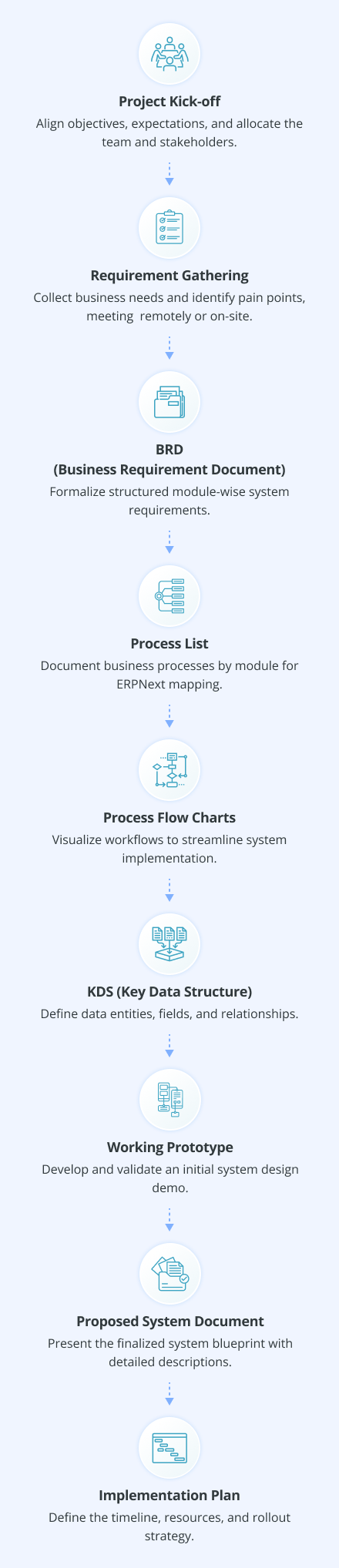
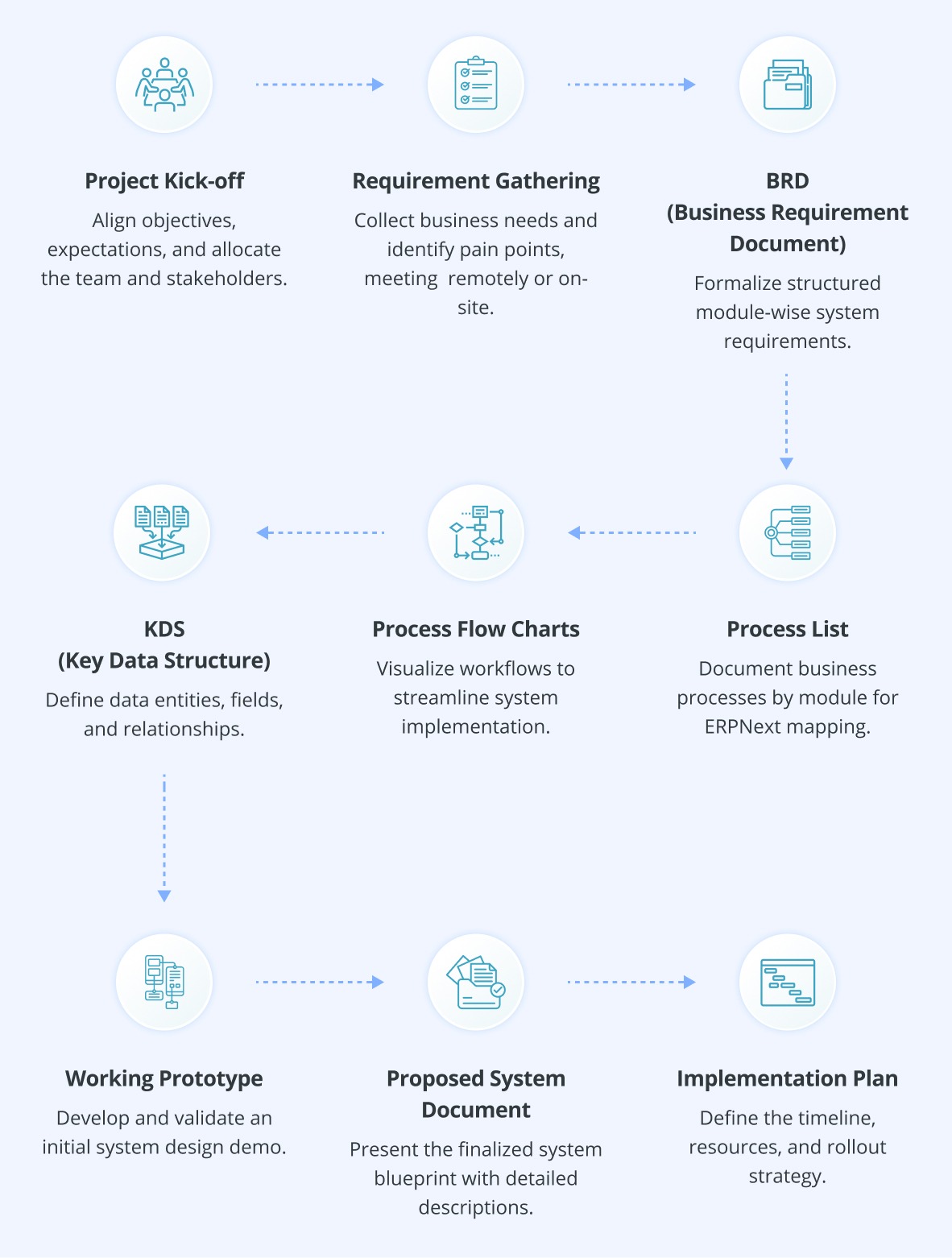
- Project Consulting Team Formation: At the beginning of this phase, a dedicated team consisting of a Project Manager and module-specialist consultants is assigned to handle the consulting activities and coordinate with the client.
- Requirement Understanding & Pain Point Analysis: The consulting team conducts discussions and workshops with stakeholders to understand business processes, operational challenges, and key pain points across departments.
- Structured Documentation Preparation: Based on these discussions, the team prepares structured documents such as BRD, Process Lists, Process Flow Charts, KDS, and system design documents (FRS) to clearly define how the future ERP system should operate.
- Client Validation & Alignment: All documents and proposed workflows are reviewed and validated with the client to ensure the designed system accurately reflects the organisation’s real business needs before moving to implementation.
Success Criteria
Area
Success Criteria
Indicator / Formula
Business Process Clarity
Success Criteria
All key business processes are clearly understood and mapped to the ERP system structure
Indicator / Formula
Process Mapping Coverage ≥ 90%
Documentation Completeness
Success Criteria
Core consulting documents (BRD, Process List, Flow Charts, KDS) are prepared and approved.
Indicator / Formula
Approved Documents ÷ Planned Documents × 100
Scope Freeze
Success Criteria
Project scope, modules, and system boundaries are clearly defined and finalised.
Indicator / Formula
Change Requests After Freeze ≤ 5%
Estimation Accuracy
Success Criteria
Project timeline, effort, and cost estimates are aligned with stakeholders.
Indicator / Formula
Estimated Effort ÷ Actual Effort ≈ 1.0
Risk Visibility
Success Criteria
Major risks, dependencies, and implementation challenges are identified and documented.
Indicator / Formula
Identified Risks ÷ Total Risks × 100
Management Confidence
Success Criteria
Leadership and stakeholders agree on the system direction and implementation plan.
Indicator / Formula
Stakeholder Approval Rate ≥ 90%
Discovery Success = Clarity × Alignment × Confidence
Discovery Templates
- BRD (Business Requirements Document): The BRD primarily documents how the current business processes
work and captures business challenges, expectations, and goals for
the ERP system.It translates the existing process and business
objectives into clear system requirements to guide ERP design and
implementation.
Sample: Click Here
- Process List: The Process List documents how the organisation currently
operates across all activities and departments. It provides
visibility into existing processes, identifies gaps or overlaps,
and helps standardise workflows before ERP system design.
Sample: Click Here
- To-Be Processes (Future-State Design): The To-Be design defines how the organisation should operate in
the future after ERP implementation. It redesigns processes by
removing gaps, improving controls, and preparing workflows for
automation, ensuring the system supports efficient and scalable
operations.
Sample: Click Here
- KDS (Key Design Specifications): KDS documents business rules, calculations, validations, and
approval logic required for ERP configuration. It provides clear
system behaviour guidelines so developers can configure the ERP
accurately and ensure all processes consistently follow defined
business rules.
Sample: Click Here
- FRS (Functional Requirement Specification): FRS defines how the ERP system should function in practical
terms, including screens, fields, validations, workflows, and
automation. It ensures the implemented system follows the agreed
design and helps reduce misunderstandings during development and
testing.
Sample: Click Here
- WBS (Work Breakdown Structure): WBS breaks the ERP implementation into structured tasks with
defined owners, timelines, and dependencies. It helps manage
project execution, track progress, and ensure activities are
completed systematically without delays.
Sample: Click Here


